-
Services
-
Connect
-
Advisory
-
Solutions
-
Technologies
-
-
Network
-
Discover
-
Regions
-
Industries
-
Must-Read Guide
-
2026 Global Software Outsourcing Rates and Trends GuideDiscover why rates are just one aspect of the Accelerance Global Software Outsourcing Rates & Trends Guide, which offers valuable insights into the software development landscape.
-
-
-
Resources
-
Our Resources
-
Newest White paper
-
Aviation Ecosystem Modernization: A Holistic Approach for Meaningful TransformationModernize aviation by integrating people, processes, technology, and data
-
-
New eBook
-
The True Cost of Software DevelopmentHidden costs can wreck your budget. Our new eBook breaks down the true cost of outsourcing—get your copy to stay ahead.
-
-
Featured White paper
-
Flow & Process OptimizationIn this white paper, you'll learn to streamline workflows, improve change management, and accelerate results.
-
-
-
About
-
About Accelerance
-
Our History
-
Accelerance: Our HistoryThere's great talent everywhere and great teams everywhere, which is the basis of the Accelerance model.
-
-
Software Without Borders
-
New Episode Every Week!Tune into our podcast Software Without Borders, the essential listen for technology leaders and business owners in the software sector who crave insights from the industry’s top minds.
-
-
Andy's Book
-
Synergea: A Blueprint for Building Effective, Globally Distributed Teams in the New Era of Software DevelopmentPeople are first and locations are secondary when it comes to software development success.
-
-
- Our Clients
-
Services
-
Software Project Delivery
-
Software Project Delivery
-
Software Project Delivery
-
Software Project Delivery
-
Engineering Advisory Services
Hands-on guidance across the people, processes, and data driving your engineering delivery.
Accelerance works as an extension of your engineering organization. We look at the people, the processes, the tools, and the data behind how your software actually gets built, then work alongside your teams to change what isn't working.
Recommendations are implemented with your team. Nothing is handed over as a report and left for someone else to adopt.
When Engineering Advisory is the right starting point
Nobody books an advisory conversation because engineering is running well. They book it because something has been wrong for two or three quarters and the obvious fixes haven't worked. If one of these sounds familiar, the constraint is more likely your operating model than your vendor.
-
Requirements arrive unclear
Teams start building against scope that was never settled. The cost surfaces two sprints later as rework nobody budgeted for. Advisory establishes a definition of ready before work starts, so scope drives cost instead of rework.
-
Estimates are unreliable
Dates get committed on numbers nobody believes. Credibility erodes with every miss, and the next estimate gets padded rather than improved. Working with an Accelerance Advisor replaces false-confidence numbers with ranges and stated assumptions, so the estimate carries its own uncertainty.
-
Releases are chaotic
Work reaches done in name and returns as defects. Every release becomes an event the whole team braces for. Advisory installs a real definition of done and a release rhythm, so shipping stops being an event.
-
The organization is in transition
A new CTO. A funding round. A strategy shift, an acquisition, a new region. Transitions put weight on an operating model that was built for the shape the company used to be. Advisory assesses whether the operating model can carry the change before you commit to it.
-
AI is in use without measurable impact
The tools are adopted and the activity is visible. The business case is still unproven. Advisory tests whether AI adoption is reaching cost, speed, quality, or throughput, not just activity.
Requirements arrive unclear
Teams start building against scope that was never settled. The cost surfaces two sprints later as rework nobody budgeted for. Advisory establishes a definition of ready before work starts, so scope drives cost instead of rework.
Estimates are unreliable
Dates get committed on numbers nobody believes. Credibility erodes with every miss, and the next estimate gets padded rather than improved. Working with an Accelerance Advisor replaces false-confidence numbers with ranges and stated assumptions, so the estimate carries its own uncertainty.
Releases are chaotic
Work reaches done in name and returns as defects. Every release becomes an event the whole team braces for. Advisory installs a real definition of done and a release rhythm, so shipping stops being an event.
The organization is in transition
A new CTO. A funding round. A strategy shift, an acquisition, a new region. Transitions put weight on an operating model that was built for the shape the company used to be. Advisory assesses whether the operating model can carry the change before you commit to it.
AI is in use without measurable impact
The tools are adopted and the activity is visible. The business case is still unproven. Advisory tests whether AI adoption is reaching cost, speed, quality, or throughput, not just activity.
What changes in your engineering operation
Advisory works in three areas. In each one, we work inside your teams rather than alongside them, and the change is meant to outlast the engagement.
01
Align
Getting agreement on the problem before anyone commits to a direction.
+
What happens
We bring your leadership, product, and engineering stakeholders to a single definition of the problem; scope, priorities, success criteria, and what "ready" actually means. Where your teams and your delivery partner diverge, we surface it and settle it.
Why it matters
Most delivery failures trace back to a decision made while people still meant different things by the same words. That gap doesn't show up in a status report. It shows up four months later as scope disagreement.
What changes
Your teams and your partners start from one definition of the problem and one definition of ready, instead of discovering the mismatch during delivery.
02
Strategy & Leadership
Senior engineering judgment applied to the decisions actually in front of you.
+
What happens
Engineering strategy, maturity assessment, AI readiness, and global scaling decisions. Where you need that judgment inside the team rather than in a recommendation, we provide fractional CTO, product, architecture, or delivery leadership.
Why it matters
The decisions that set your engineering trajectory tend to arrive faster than you can hire for them. Waiting two quarters for the right leader means the decisions get made anyway, by whoever is available.
What changes
You get experienced engineering leadership on the decision at the moment the decision is being made, without carrying the headcount permanently.
03
Ways of Working
The delivery practices that decide whether distributed teams produce reliable outcomes.
+
What happens
Governance, estimation discipline, delivery cadence, and definition of done — installed in how your teams actually work, and run with the people who have to sustain them.
Why it matters
Distributed delivery exposes every weakness in a process that a co-located team could absorb informally. Practices that were tacit have to become explicit, or the distance breaks them.
What changes
Your delivery becomes predictable enough to plan against, and your partners are held to the same standard as your internal teams.
“The new development team accomplished about 60% of our planned yearly development in just six months.”
Rob Hilliard
CIO, Academic Partnerships

FIND THE TRUE COST OF YOUR ENGINEERING TEAM
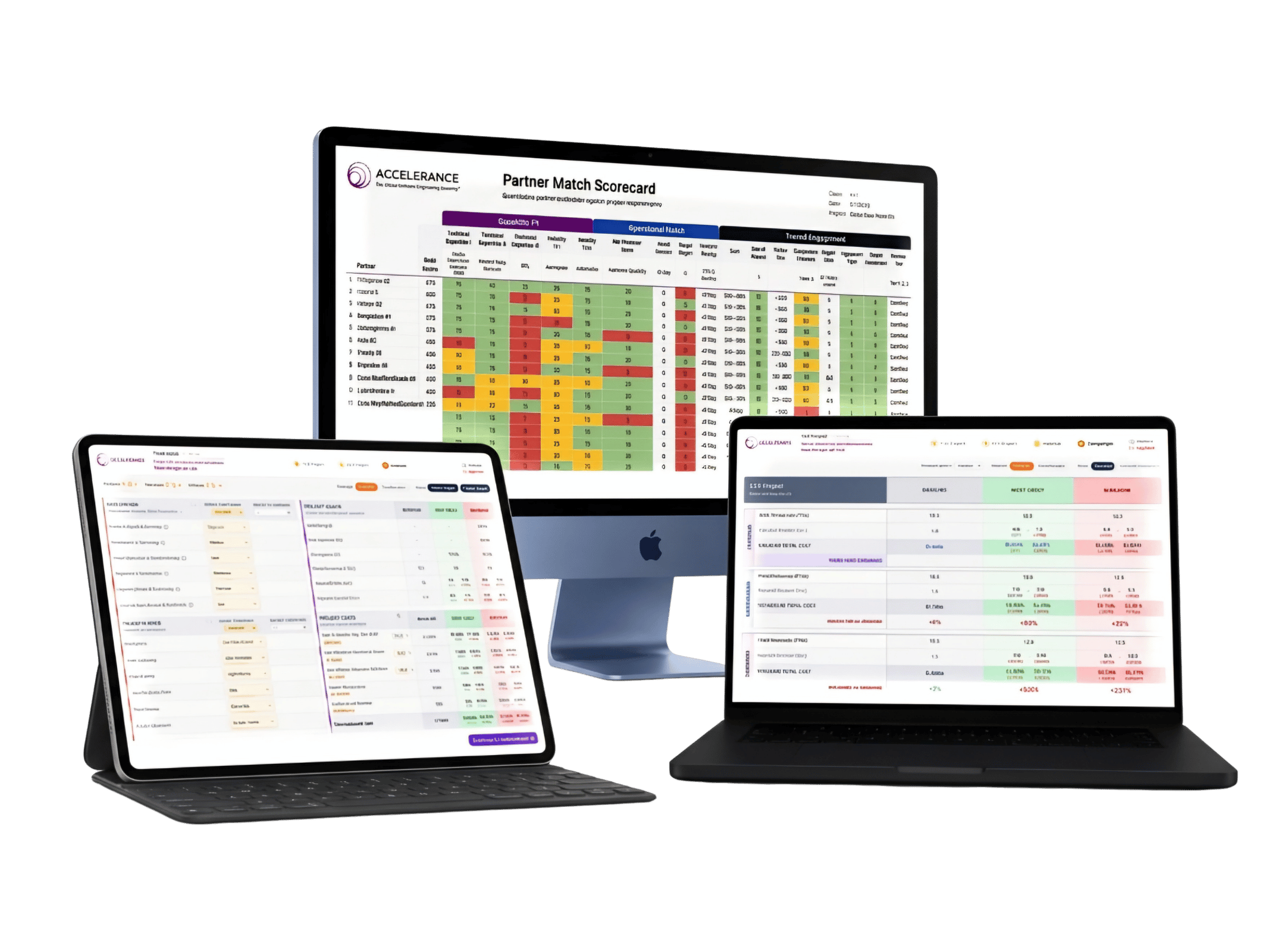
TrueCostIQ is a proprietary diagnostic tool developed by Accelerance that makes hidden engineering costs and delivery risks visible.
Go beyond the hourly rate and into the total cost of development, which is driven by estimation quality, architecture, process maturity, collaboration efficiency, and rework.
Before you compare partners on rate, it is worth knowing what the work will actually cost to deliver.
ADVISORY AND CONNECT
Connect answers who. Advisory unearths the conditions to maximize your success.
Where both apply, the sequence matters more than the combination. If the roadmap or problem is undefined, if internal alignment is missing, or if you want the strategic decision worked through rather than handed over, Advisory comes first.
A partner search built on an unclear problem produces a confident answer to the wrong question.
Frequently Asked Questions
How is Advisory different from general management consulting?
Advisory is engineering-specific and hands-on. We implement recommendations alongside your teams rather than delivering a report and leaving it behind.
Does Advisory replace our current partner or team?
No. Advisory works alongside you and your team to close gaps in requirements, estimation, governance, or delivery rhythm.
Who at Accelerance does the Advisory work?
Advisory engagements are led by Accelerance's fractional advisory team: experienced CTOs, product leaders, architects, and delivery leads who embed with your organization for the length of the engagement.
How long does an Advisory engagement run?
Engagement length depends on the scope of the problem and what your organization needs. We set it with you during the initial assessment, before any commitment.
What happens if the diagnosis points back to a partner problem?
Accelerance Advisory connects you into Connect's partner selection process and stays through onboarding and the early delivery cycles that follow.
When should we start with Advisory instead of Connect?
Start with Advisory when the problem or roadmap is undefined, leadership isn't aligned on what needs to be built, or a previous partner underperformed for reasons you cannot yet name.
What does an Align engagement actually involve?
Align brings your team and your delivery partner to operate as one team, not two groups working across a contract. It aligns goals, expectations, culture, roles, communication, and shared methods, so the relationship starts aligned instead of uncovering issues months later.
What does Advisory look for when assessing operating-model risk?
The assessment applies the same rigor as a partner audit, but focuses on your operating model. It examines how requirements move from idea to ready, whether QA and security withstand delivery pressure, the transparency of cost and scope tracking, and whether team–partner collaboration can sustain the needed pace. It identifies where the operating model, not the partner, is the constraint.
Before you shortlist a replacement partner
It's worth establishing whether the partner is the constraint. That question has an answer, and reaching it takes less time than a vendor search.