November 11, 2026
For several years now, artificial intelligence has been steadily moving in from the edges of software engineering to the centre.
 But 2026 is the year AI in software development became routine infrastructure worldwide. Stack Overflow's 2026 Developer Survey drew more than 30,000 responses. Among developers using AI, 66% work with coding agents and 63% with AI chatbots, and a third of daily AI users spend four or more hours a day with AI tools.
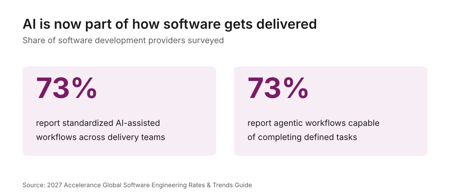
The picture is consistent with Accelerance's own provider survey. Seventy-three percent of providers report standardized AI-assisted workflows across delivery teams, and the same share report agentic workflows capable of completing defined tasks.
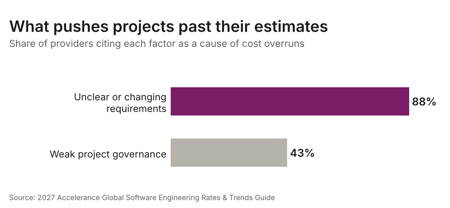
Yet 88% still cite unclear or changing requirements as a reason projects exceed estimates, according to Accelerance’s provider survey. AI can accelerate delivery, but it cannot resolve weak product decisions or poor governance.
The 2027 Accelerance Global Software Engineering Rates & Trends Guide shows AI moving across the entire delivery lifecycle: planning, coding, testing, documenting, integrating, and supporting software. For technology leaders, the useful question has moved on from whether their development partners use AI to whether they use it well.
Beyond code completion: AI across the software delivery lifecycle
The early phase of generative AI in software development focused on coding speed. Developers used assistants to suggest functions, explain unfamiliar code, generate boilerplate, and speed up routine tasks. The next phase is broader. AI is now being applied across the delivery lifecycle, from early discovery through to quality assurance. It can generate test cases, analyze documentation, summarize complex codebases, help diagnose defects, automate routine reviews and support technical research. It can also help teams surface patterns that would otherwise take hours to find.
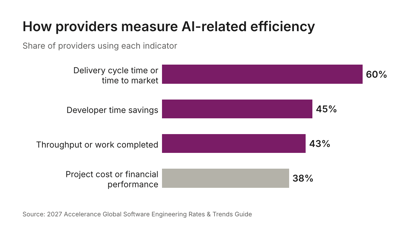 Our survey of providers across our global network, including Latin America, Asia, and Eastern Europe, shows they are starting to measure AI productivity through delivery outcomes rather than novelty. Sixty percent use delivery cycle time or time to market to measure AI-related efficiency. Forty-five percent track developer time savings, 43% measure throughput or completed work, and 38% look at project cost or financial performance.
That is an important maturation. AI is moving from "we have access to these tools" to "show us what they changed."
Still, the numbers need a careful read. Measuring cycle time isn't the same as proving every AI-enabled project is faster or better. The impact depends on codebase maturity, architecture quality, data sensitivity, domain complexity and the quality of human oversight.
AI amplifies the environment it works in. In a well-run engineering environment, that can be powerful. In a poorly managed one, it can create more confusion, faster.
Bain & Company's 2026 Global Technology Report, released in late September, found developers completing roughly 21% more tasks with AI coding tools, while time spent reviewing outputs rose 91%.
That shift is also changing which engineering skills matter most.
The bottleneck shifts upstream
AI can make code production easier. But producing code was never the only hard part of building software.
 The hardest work often happens before anyone opens an integrated development environment (IDE). It's deciding what problem to solve, agreeing on priorities, defining the user experience, resolving trade-offs, designing the architecture, and determining what "done" actually means.
Our survey makes this clear. Eighty-eight percent of providers say unclear or changing requirements contribute to projects exceeding their original estimates. Weak project governance follows at 43%.
That makes sense. The more AI can take on routine implementation, the more valuable people become who can frame the problem, design the system, set guardrails, integrate services, and judge whether the output is fit for purpose.
The best teams in 2027 may not look like traditional pyramids built on large pools of junior developers. They may be smaller, more senior and more specialized, with architects, platform engineers, domain experts and delivery leaders taking on a greater share of the work.
There is a catch. A third of providers (33%) report fewer junior engineers, while only 10% report more juniors with AI skills. If AI absorbs the tasks that once helped juniors learn the craft, the industry has a pipeline problem to solve. Strong providers will need new apprenticeship models that give early-career engineers exposure to real design, quality, and customer decisions, not just AI-generated code.
The next test: trust in AI-assisted delivery
The next wave of AI adoption will be defined less by who has the most tools than by who can make AI trustworthy in production.
That means clear rules around data, intellectual property, security, code provenance, human review, and accountability. It means being able to explain where AI is used, what it can do, what remains under human control, and how quality is verified.
Questions to ask an AI-ready software development partner:
-
Which parts of the delivery lifecycle are AI-assisted?
-
Where are agentic workflows being used, and what decisions can they make?
-
How do you review, test, and secure AI-generated code?
-
What client data enters AI systems?
-
How are gains in speed, quality and cost measured?
-
Who is accountable when an AI-enabled process gets it wrong?
The providers that answer those questions clearly will have an advantage. The guide outlines six capabilities to validate before you commit.
What AI in software development means for 2027
AI is not replacing software development. It is redesigning it. In 2027, the teams that pull ahead will combine machine speed with human judgment, disciplined governance, and a clear focus on building the right thing.
For what AI engineering roles cost by region, see Software Engineering in 2026: Rates Held, Expectations Rose.