April 22, 2026
AI is now the heartbeat of the modern workforce. But in highly regulated industries, AI’s speed just raises the stakes. In industries like education, healthcare or law, the faster work moves, the faster risk can spread across systems, data, and workflows.
 The moment AI touches sensitive data, internal systems, or third-party workflows, it stops being just another productivity story. It becomes an evolving cybersecurity story, too. One where prevention and preparation are top of mind.
In the meantime, the global average cost of a data breach is $4.44M.
Yet, many organizations aren’t doing enough. AI ambition is now outpacing readiness, with organizations taking on new responsibilities around AI and data governance without feeling fully prepared.
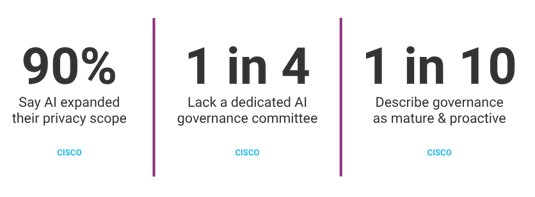
Reports Cisco’s 2026 Data and Privacy Benchmark Study, 90% of organizations say AI has expanded the scope of their privacy programs. Almost all — 93% — plan to invest more in privacy and data governance over the next two years.
But readiness still lags, with one in four still lacking a dedicated AI governance committee. Only one in ten surveyed describes their current governance structures as mature and proactive.
What are the greater implications of this? Action is urgently needed. According to IBM, the AI oversight gap must be closed.
"AI ambition is outpacing readiness. The AI oversight gap must be closed."
To close this gap, control must become a top priority
 HIPAA is just one of many examples. The HIPAA Security Rule, for instance, requires covered entities and business associates to protect electronic protected health information through administrative, physical, and technical safeguards. Once AI touches ePHI, is the environment around it secure, traceable, and appropriate?
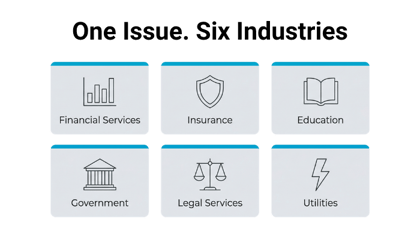
Highly regulated industries, including ones we at Accelerance serve, like financial services, insurance, education, government, legal services, and utilities face the same core issue. Once AI enters the workflow, leaders need to know where data is going, who can access it, what vendors or models are involved, and how outputs are being reviewed before they move downstream.
Highly regulated organizations already know that not all data carries the same level of sensitivity. Some is governed by industry-specific rules. Some is confidential by contract. Some is so operationally or reputationally sensitive that exposing it casually creates immediate business risk.
Did you know? Stolen Protected Health Information sells for up to $363 per piece. Medical data is highly valuable on the black market because it involves hard-to-change medical history information.
AI accelerates movement. That movement can include prompts sent to public or third-party models, internal documents routed through retrieval systems, agents calling APIs, outsourced teams using the same tools, or outputs flowing into customer-facing, patient-facing, or business-critical decisions.
NIST’s AI Risk Management Framework Playbook makes that clear, stating that “lack of clear information about responsibilities and chains of command will limit the effectiveness of risk management.” The larger issue is the management environment around AI use, such as roles, access, permissions, review paths, accountability, and control.
That means AI cannot operate as a black box inside a regulated workflow. Teams need system inventories, defined owners, monitoring procedures, incident response plans, and oversight of third-party tools before AI-driven risk turns into a security, compliance, or operational failure.
AI in a Regulated Environment: A Real-World Case Study
| Challenge | In healthcare, downtime in eye laser surgery equipment caused costly service callouts, patient rescheduling, and workflow disruption. |
| How Accelerance helped | An AI-driven predictive maintenance solution used sensor data to identify patterns, anticipate equipment failures, and optimize scheduling based on equipment availability. |
| Why this matters | In regulated industries, AI does not operate in a vacuum. It affects critical workflows, patient experience, and operational continuity, which is exactly why visibility and control matter as adoption grows. |
The Real Risk Is Operational
The biggest AI risk in regulated industries is the business context around how AI is being used. For example:
- A healthcare operations team may use AI to summarize patient communications.
- A finance team may use it to process complaint data faster.
- An education provider may connect it to internal records for support workflows.
- A legal or professional services firm may use it to accelerate drafting and research.
Each of those actions may look small at first. Together, they create larger questions, like:
- Was the data approved for that use?
- Was the model approved?
- Were prompts retained?
- Was access limited?
- Can the business explain how the output was produced and who reviewed it before acting on it?
These are operating questions versus nice-to-have questions. Because human oversight, by itself, is a start, but not enough. You don’t know what you don’t know. A human in the loop only works if that person is trained, accountable, and empowered to challenge, override, or stop the process when needed. Otherwise, oversight becomes a formality rather than a control.
Without Visibility, Silent Risks Spread
Without a clear framework, AI spreads informally and messily. Teams move quickly. Tools overlap. Sensitive data starts flowing into systems that were never approved for that level of access. Security, legal, and compliance teams step in late. Then the initiative stalls because nobody built the controls needed to scale it.
Reuters, for example, reported that Samsung temporarily restricted employee use of generative AI tools after discovering sensitive code had been uploaded to ChatGPT. The lesson extends far beyond software development. In a regulated industry, the same pattern could involve patient data, financial records, confidential files, or regulated internal information. And output risk is just as real.
In March of 2026, Reuters reported a U.S. appeals court fined attorneys $30,000 after filings included fake case citations and other errors that bore signs of AI hallucinations. The bottom line is that when output cannot be trusted or traced, automation creates liability faster than it creates value.
Did you know? The percentage of synthetically-generated text in malicious emails doubled over the past couple of years, rising from five to ten percent, found Verizon.
Why Assessment Matters Now
The market is full of AI adoption. It is much thinner on a durable, well-governed deployment.
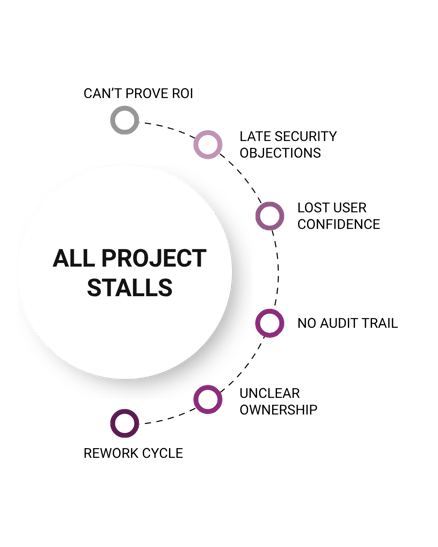
Projects stall for predictable reasons. Leadership cannot prove ROI. Security objections arrive late. Business users lose confidence in the output. Legal and compliance teams discover there is no audit trail. No one is fully sure who owns the system.
That is why assessment matters before exposure turns into an incident.
Highly regulated companies do not need to stop using AI, as doing so would cause them to lag behind the competition. They simply need a clearer understanding of where risk begins, how data moves, where access is too broad, and which controls are missing before those gaps become expensive.
What a Real Assessment Looks Like
A real assessment goes beyond broad AI caution. It goes deeper to look at the systems and applications already in place, reviews prior breaches or serious issues, maps digital assets, identifies critical vulnerabilities, analyzes likely threats, and determines which compliance requirements apply. That visibility gives organizations a stronger foundation for building a cybersecurity plan, long before AI-driven risk turns into an incident.
A practical blueprint for getting started
Start small, but structurally. A useful approach begins with a few operating moves, such as:
 Assess
Map where AI is already being used across teams, vendors, and workflows. Identify which systems touch sensitive data, where exposure points exist, and which regulated requirements apply to your environment. Accelerance’s own cybersecurity process, for example, starts here: scoping infrastructure, evaluating vulnerabilities, understanding threats, and identifying compliance requirements.
 Plan
Plan
Once the risks are visible, define what good looks like. Set security goals that align with business priorities. Establish policies for access control, data handling, incident response, and acceptable AI use. Clarify who needs to know what, and when.
 Build
Build
Put the controls into practice. That means deploying the right security technologies, strengthening data protection, enforcing least-privilege access, and pressure-testing anything that connects to public-facing systems. AI use cannot stay informal once regulated data enters the workflow.
 Train and transition
Even a strong framework breaks down if teams do not understand it. Communicate the new policies clearly, support adoption, and make security awareness part of everyday work. Accelerance’s framework emphasizes change management, ongoing training, and continuous improvement so controls hold up beyond rollout.
 Maintain
Cybersecurity is not a one-time project, and neither is AI risk. Review controls regularly. Update systems and patches. Run audits and pen tests. Track new threats. Retrain employees. In regulated environments, durability matters as much as setup.