April 15, 2026
AI is now part of everyday work in most engineering organizations. Engineering teams use it to write code, review pull requests, write tests, summarize tickets, and speed up delivery. Business teams use artificial intelligence to automate documentation, workflows, internal research, and support tasks. Meanwhile, agentic systems are connecting once-separate steps, moving information from tool to tool with less human intervention.
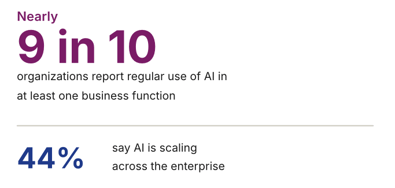 Nearly nine in ten organizations now report regular use of AI in at least one business function, according to McKinsey's State of AI in 2026. In software delivery, it runs deeper still: 73% of software development providers report standardized AI-assisted workflows across their delivery teams, according to Accelerance's 2027 Global Software Engineering Rates & Trends Guide.
AI's most visible payoff is speed. Bain & Company's 2026 Global Technology Report found developers completing roughly 21% more tasks with AI coding tools. It also found that time spent reviewing AI outputs rose 91%.
This is where governance comes in.
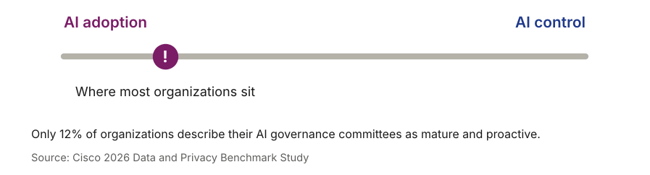
Adoption is no longer the hard part. Control is
There are clear risks in speed. However, given that AI is embedded in all devices, we can be fairly certain that adoption will take place. But we cannot be sure of control.
That makes governance a long-term operating model rather than a one-time compliance exercise.
"Lack of clear information about responsibilities and chains of command will limit the effectiveness of risk management," the NIST AI Risk Management Framework Playbook explains.
For AI to be used effectively in line with its use case and risk management throughout deployment to production, governance must be in place. This determines who has what role and responsibility in order to allow AI to be effectively utilised, audited and scaled within the business.
The biggest AI risk is operational
The biggest AI risk is often not the model in isolation. It is the business context around AI use.
More human oversight alone is not a cure-all. A human in the loop only works if that person is trained, accountable, and empowered to challenge, override, or shut down the system. Otherwise, oversight becomes a box to tick instead of real control.
Whether AI use is "good" or "bad" isn't the right question. More useful questions, especially around privacy and data exposure, include:
- Where are our AI systems being used?
- Who is affected?
- What happens when AI use creates data, inputs, advice, or analysis that is wrong?
- How do we recognize when it is wrong, and at what stage in the process?
- Should a task have been automated in the first place?
AI models can introduce risk over time if not monitored. This could come in the form of model drift, incorrect usage, changed inputs, or dependencies on third party systems, or unforeseen use-cases. However, businesses that have sustained value out of their AI will be those that can monitor its use. This is due to implementing monitoring processes, feedback mechanisms, response processes, and review mechanisms, as well as deploying these prior to the system going live.
Without a governance model, silent risks spread
Without a governance model, AI spreads informally and unevenly. Teams move quickly. Tools overlap. Sensitive data starts flowing into systems that were never approved for that level of access. Costs rise quietly. Output quality becomes uneven. Security, legal, and compliance teams step in too late, and the initiative stalls because no one built the controls needed to scale it.

This is a mismanagement issue rather than an AI issue.
In the 2026 Data and Privacy Benchmark Study by Cisco, 90% of organisations have increased their privacy programs due to AI but 23% still do not have a specific AI governance committee. 93% are planning to invest more in privacy and data governance in the next two years but only 12% have mature and proactive AI governance committees.
AI governance starts with operating decisions
Questions worth asking include:
-
Which use cases are approved?
-
Which are experimental?
-
What data can be used in prompts, retrieval systems, or agent workflows?
-
Which tools can connect to internal systems?
-
Who can use them?
-
What level of review is required before output becomes code, customer-facing content, or a business decision?
Those are governance questions. They are also execution questions, and that matters even more in software development and outsourced delivery, where work moves across internal teams, contractors, external partners, and increasingly autonomous systems. The 2027 Rates & Trends Guide makes the same point for buyers: assess a prospective partner's AI delivery model as seriously as its technology stack, and ask what data enters the tools, who owns the outputs, and what remains subject to human review.
Forrester highlights that “a point-in-time, reactive, and narrowly data-focused approach to responsible AI will simply not cut it”. As agentic AI tools make decisions independently, spanning multiple tools, data sets, and user contexts, and often altering the environment for subsequent decisions, governance must be able to provide real-time oversight, responsibility, and control.
If you can’t explain how an AI output was created, what data was used, what model was used, and who approved it, you are lacking governance. You have speed without transparency.
Accountability matters. "AI actors should ensure traceability," the OECD AI Principles state, "to enable analysis of the AI system's outputs and responses to inquiry." In practice, teams need a visible chain from input to model to output to owner. Without it, they cannot investigate errors, challenge decisions, or prove accountability when something goes wrong.
Why data movement is the core AI governance question
The most important governance question is not whether your company should use AI. It is how information moves once AI enters the workflow.
That includes prompts sent to public or third-party models, proprietary code exposed in development tools, internal documents feeding retrieval systems, agents calling APIs or triggering other applications, and outside vendors and outsourced teams working across the same systems.
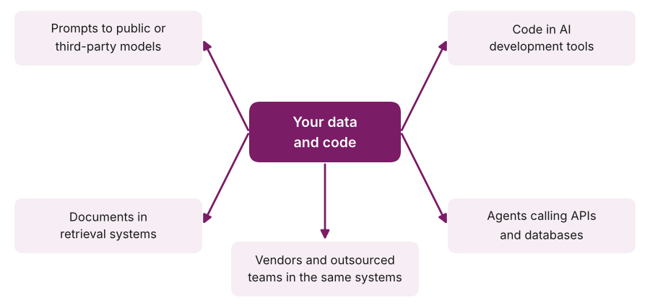
Exposure can lead to:
- HIPAA violations when protected health information enters an unapproved tool (see how this plays out in AI adoption in regulated industries).
- Supply chain disruption.
- Operational instability.
- Bias that creates reputational or legal risk.
- Confidential data reaching the wrong people.
- Improper data retention or storage under rules like GDPR.
What happens to a prompt after it is sent depends on the provider's terms and the account's settings. Employees working against a deadline don't always check either.
In 2023, Samsung restricted employee use of generative AI tools after engineers uploaded sensitive source code to ChatGPT, Reuters reported. Internal information left the company through a routine shortcut.
The lesson: once AI becomes part of the workflow, data movement becomes harder to see and easier to underestimate. That is why governance must include controls around access, permissions, logging, model connections, and data classification.
Once AI becomes part of the workflow, data movement becomes harder to see and easier to underestimate.
The OWASP Top 10 for LLM Applications flags risks including sensitive information disclosure, misinformation, and excessive agency. Those risks grow as AI systems are given broader permissions and access to other tools.
OWASP ranks prompt injection first. AI can be manipulated by websites, files, emails, or images that contain hidden instructions. A person may never see those instructions, but the AI can still read them and change its behavior, give a misleading answer, reveal information, or take the wrong action. The risk is not just that bad content exists. It is that an AI may treat untrusted content as instructions unless the system is designed to prevent it. For example, a user asks an LLM to summarize a webpage that contains hidden instructions, and the LLM inserts a link or leaks part of the private conversation.
The fix is to be selective about AI access. Not every employee needs the same AI access. Not every model should see the same data. Not every workflow should run autonomously. Not every vendor should inherit access by default.
Security, cost, and accuracy rise or fall together
Security failures often begin with convenience. The Samsung case shows how quickly internal data can move into external systems before governance catches up, and why AI breach risk is harder to see than a traditional breach until it becomes an incident.
Cost failures are quieter. They show up as unmanaged tool sprawl, overlapping pilots, duplicated effort, rising model spend, and expensive human review layered on top of weak output. When a breach does happen, the bill is large: IBM's Cost of a Data Breach Report 2026 puts the global average cost of a data breach at $4.99 million.
Accuracy failures undermine everything else. If output cannot be trusted, automation fails. In March 2026, Reuters reported that a U.S. appeals court fined two attorneys $30,000 after filings included fake case citations and other errors the court said bore hallmarks of AI hallucinations. Unverified output creates liability.
Why AI governance matters now
According to McKinsey (2026), 44% of AI is being scaled within enterprises. 37% have seen value in EBIT.
However, projects may run into issues. Lack of clear ROI is observed by leadership. Security concerns may surface. Confidence in results from business users may decrease. Engineering resources may be used in tidying up processes which were meant to save time. Compliance and legal teams may see there is no auditability in place. There is also uncertainty in ownership of the system.
Even without AI, governance is an issue. In 2027, it was found by the Rates & Trends Guide that 43% of software development providers had projects overrun due to poor governance.
Good governance ensures clear ownership of AI across engineering, security, legal and business teams. It enables defined data sharing between people, models and agents. The model can be audited, and outputs measured. Organisations can improve these systems rather than closing them off at the first signs of risk.
While regulation creates pressure, it is not the only consideration. Within the EU, the Digital Omnibus on AI was implemented in July 2026. This has delayed high-risk requirements in the AI Act. For standalone systems, they are no longer required until December 2027, and for AI within regulated products, until August 2028. However, this delay should not be seen as an excuse to delay action. Implementing governance into your operations model now will put you in a stronger position than businesses who see governance as a compliance issue in the future.
Businesses who will gain long-term benefits from AI will implement a management layer to ensure effective automation in practice.
A practical AI governance framework in six steps
Start small, but start structurally. A useful governance model begins with a sequence of operating moves, such as:
 Assess: Map where AI is already being used across engineering, operations, support, vendors, and business teams. Identify unapproved tools, sensitive data exposure points, and high-risk workflows.
 Prioritize: Separate experimental use cases from production use cases. Focus first on a narrow set of high-value workflows where speed matters and risk is manageable.
 Control: Define what data can be used, which models are approved, who gets access, what integrations are allowed, and where logging is required. Tie permissions to roles, not convenience.
 Evaluate: Set standards for output quality, human review, escalation, and traceability. Measure success using error reduction, rework, cycle time, defect rates, and business impact, not just tool adoption.
 Operate: Establish named owners across engineering, security, legal, and the business. Create incident response, change management, and model review processes before the system scales.
 Improve: Review the framework continuously. AI risk changes after deployment, not before it. Governance has to evolve with model behavior, vendor changes, and new workflows.
Is your AI governance improving delivery?
If AI is already part of your engineering workflows and you can't yet tell whether it is improving delivery, that is a governance question as much as a technology one. Accelerance Advisory provides hands-on guidance across the people, processes, and data driving your engineering delivery. We help teams assess readiness, set the controls and review paths that make AI auditable, and measure whether gains are reaching cost, speed, quality, and throughput.